The Book
Pathognomonic Signs of Disease
A first-of-its-kind visual atlas of diagnostic certainty: what the sign looks like, why it happens, what disease it suggests, and whether it truly deserves to be called pathognomonic.
The Book
A first-of-its-kind visual atlas of diagnostic certainty: what the sign looks like, why it happens, what disease it suggests, and whether it truly deserves to be called pathognomonic.
Click any image to enlarge
About the Book
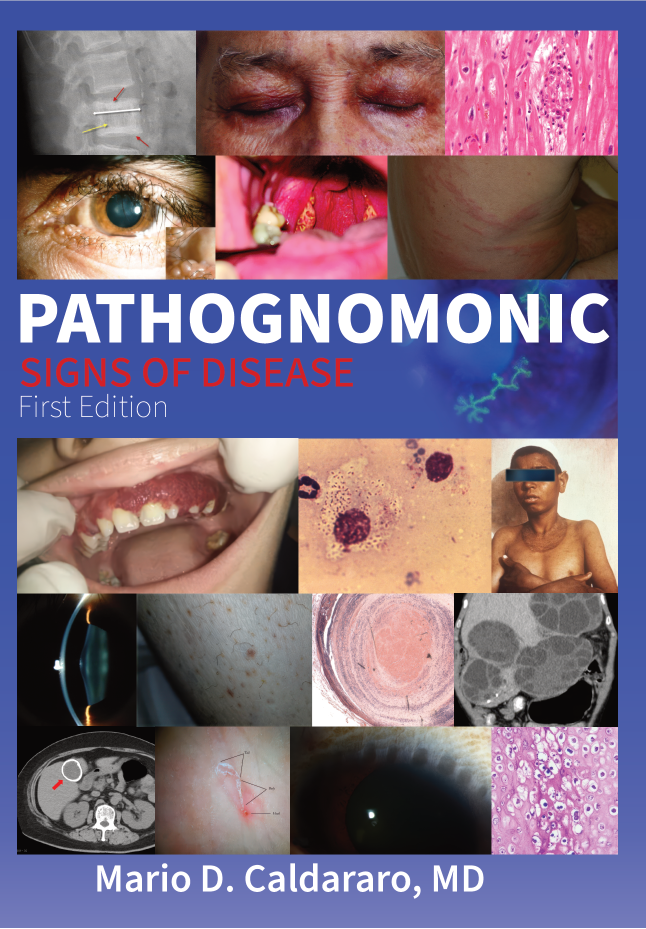
Pathognomonic Signs of Disease is a collection of physical, radiographic, and microscopic findings that medical education teaches as diagnostic clinchers, all inside one practical, full-color visual atlas. Each entry explains the appearance of a classic finding, the disease it is associated with, the mechanism behind it, important mimics or exceptions, and an evidence-based final verdict on how specific the sign really is.
Bates and Macleod teach us how to look, and then we spend the rest of our lives learning how to understand what we see.
This book is for anyone who wants to learn about the most powerful diagnostic signs in medicine: from medical students to residents to nurses to PA's. It's designed to serve students across disciplines and throughout all the levels of their education.
Flip through it for quick high-yield associations between the sign and its disease, making for a quick study for your upcoming exams. Spend a few minutes reading about how a question writer might describe such findings if they're trying to be cagey and avoid using the more common eponym.
Go a level deeper and read about the disease mechanism that produces the sign, reinforcing some of the content you learned in your foundational classes, solidifying your understanding of the human body, and preparing you further for a second- or third-order question.
Go deeper still to learn the disease's history, exploring when and why the sign started to be thought of as a spot diagnosis. That history of medicine pimp question in your future doesn't stand a chance.
Land finally at the evidence review and final verdict where you find out how useful a sign actually is, for you and the people you'll take care of. Stand up against the gravity of a "textbook" sign and answer the question: can I really use this in my practice? Is it really pathognomonic?
Available now in signed paperback, eBook, and study bundles.
Not ready to buy? Get the free sample + mini Anki deck.
High-quality images of 72 major signs and 20 honorable mentions across multiple specialties and disciplines, the vast majority curated from primary peer-reviewed sources.
Why does the sign occur? Each entry explains the underlying pathophysiology in detail, showing us how a disease produces a particular sign.
How did the sign first get recognized? How did it become linked to its disease? And when/why did it start being called pathognomonic?
Critical appraisals of original research and case reports for each sign to separate reality from diagnostic mythology.
What else can mimic this sign? Each entry addresses the key mimics and distinguishing features.
Dermatology, ophthalmology, cardiology, toxicology, infectious disease, and more, all in one volume.
A Note from the Author
During my medical school clinical rotations, one of my attendings spoke of a sign so specific, it could immediately point to a disease. That's when I first heard the word pathognomonic, and I was instantly hooked. From then on, I began hunting for all those signs, writing them down whenever I encountered them, collecting them like exotic artifacts. I promised myself one day I would put them all in one place, not just to study and memorize, but to scrutinize intently and find out if they really deserved the superlative title attached to them. That day has finally come. Pathognomonic Signs of Disease is the product of years of study culminating in one massive ongoing project. I hope you'll come along on this tour through all of medicine, where we become both admirers and skeptics of this lost art.